I decided to read this book because I love a good disaster story. Bower specializes in writing takedowns of unpleasant people, so I thought most of it would be scurrilous gossip a la Kitty Kelley, but a great deal of it is actually about failures of economic understanding. I know about as much about economics as George W. Bush did about the interplay of ethnic and religious forces in the Middle East, so I have conveniently translated what I could understand of the action into Liberal Arts Major-ese.
Gordon Brown, by Tom Bower: The Play
starring Our Heroes (civil servants, anybody with a working grasp of economic theory)
Gordon Brown
Act I
The setting: an office
Our Heroes: Hey, what's up? Can I look at that policy you're working on?
Gordon Brown: No, because I'm a control freak with problems! I grew up in a manse!
OH: Come on, just a tiny peek.
GB: Noooooooo!
He attempts to eat the paper, but failing, decides to hide his work by sitting on it instead.
Act II
Later that day Our Heroes sneak into the office and find that Brown's cunning plan of concealment has failed. He failed to perceive that when he got up from the chair, the notes would once again be visible to his enemies!
Our Heroes: Jesus Christ! This is an unholy marriage between neoliberal economic theory and state interference! It will never work!
Brown springs from underneath his desk. He was hiding the whole time!
GB: It will too work, because I said so!
Brown savagely beats them to death, then steals their policies for himself.
GB: I am a genius!
Choral interlude
Brown appears underneath Tony Blair's window to sing him a beautiful song. ORCHESTRA appears, Charlie Whelan on synth, Ed Balls on the panpipes.
"Freeze, freeze, thou bitter sky,
Thou dost not bite so nigh
As means-tested benefits forgot:
Though thou the waters warp,
Thy sting is not so sharp
As friend remember'd not..."
WHEN'S IT MY TURN AT THE BIG JOB? YOU PROMISED, TONY!
Act III
The economic plan fails... because it was stupid!
The cycle repeats for about 300 pages, and Bower has to end with another round of this nonsense and some "what does the future hold?" speculation because he published before it became clear that Brown would get to be PM. Reading the speculation now is strangely upsetting, like reading a truncated version of "Carrie" that ends right before Carrie goes to the prom. "Would Gordon be elected prom queen? Would this be the best prom ever? I don't know, but time will tell!" Cue pigs' blood, fire, and a whole lot of laughing at you.
Anyway, now you without counting skills have read the nasty biography of Gordon Brown. Oh, I forgot, he was mean to his girlfriends for some vague reason that may or may not be actionable under libel law. Now you've read it.
Showing posts with label look at my learnings. Show all posts
Showing posts with label look at my learnings. Show all posts
Monday, 30 June 2008


Thursday, 26 June 2008
"Servants of the People: The Inside Story of New Labour," Andrew Rawnsley
I have been on a politics reading kick lately. It's embarrassing; I promise to make up for it by reading something less horribly dorky, like a romance novel or something about space soldiers commanding armadas of space dragons. Bear with me, I am sure I will recover soon!
Frankly, I should have known better in another way; history makes for better reading after all the participants are dead, because then you can get all the gossip and cod psychoanalysis in without the danger of libel suits popping up. But I keep forgetting this, to my detriment. Stupid contemporary history! You can't have a proper narrative without knowing how things end! (I felt like writing in little epilogues for all the "characters" on the endpages.)
Anyway, according to Rawnsley, Tony Blair became Prime Minister and some things happened (not Iraq, the book was published before that shitstorm came to rain feces upon the land). Everything that happened, good or bad, made everyone involved feel terribly insecure, because they were all terrible fakes. Rinse, repeat, the end.
The one part of the book that really sticks in my head is the account of the 2000 London mayoral election, mainly because Rawnsley keeps making newt-themed puns at the expense of Ken Livingstone, the now ex-mayor. By the end of the book I was half-reading, and half thinking about newts and why they were so important to Red Ken - so important that Rawnsley had to bring them up every damn time the man was mentioned. I came to a conclusion: The newts were obviously Ken's spirit animals, the amphibian equivalent of Dick Whittington's cat. I like to think that Ken would go riding round London at night on a giant newt, visiting all of his ten bajillion children and maybe siring some more along the way. That's why he lost the mayoral election; the giant newt died and without its psychic powers he is nothing. I wonder where it is buried?
Frankly, I should have known better in another way; history makes for better reading after all the participants are dead, because then you can get all the gossip and cod psychoanalysis in without the danger of libel suits popping up. But I keep forgetting this, to my detriment. Stupid contemporary history! You can't have a proper narrative without knowing how things end! (I felt like writing in little epilogues for all the "characters" on the endpages.)
Anyway, according to Rawnsley, Tony Blair became Prime Minister and some things happened (not Iraq, the book was published before that shitstorm came to rain feces upon the land). Everything that happened, good or bad, made everyone involved feel terribly insecure, because they were all terrible fakes. Rinse, repeat, the end.
The one part of the book that really sticks in my head is the account of the 2000 London mayoral election, mainly because Rawnsley keeps making newt-themed puns at the expense of Ken Livingstone, the now ex-mayor. By the end of the book I was half-reading, and half thinking about newts and why they were so important to Red Ken - so important that Rawnsley had to bring them up every damn time the man was mentioned. I came to a conclusion: The newts were obviously Ken's spirit animals, the amphibian equivalent of Dick Whittington's cat. I like to think that Ken would go riding round London at night on a giant newt, visiting all of his ten bajillion children and maybe siring some more along the way. That's why he lost the mayoral election; the giant newt died and without its psychic powers he is nothing. I wonder where it is buried?
Friday, 14 March 2008
"Regeneration," Pat Barker
The professor who assigned this book for class did so because he wanted to tear it down and complain about it in public, which is a noble cause and certainly more interesting than when everyone pretends to like the book, but still it isn't quite as bad as he made out. (As everyone knows, the worst assigned reading-type book ever is Ian McEwan's "Saturday," or if you want to go back to the American high school experience, probably "The Scarlet Letter." It's scientifically proven, they keep a copy of "Saturday" in a vault somewhere, just like they used to do with the meter bar. Really!)
In any case, the book read a little like fanfic, which I guess it is - real person fanfiction starring the war poets. Everyone is a little too nice and they all solve their problems by talking them out (which makes sense for a book about psychoanalysis, in a way, but still). Also, everybody is gay.
I might be biased because "Regeneration" is part of a trilogy and I read the 2nd book, "Eye in the Door," first, and that book is all about hustling and blackmail and pacifists starving themselves and 47,000 perverts. Maybe I was expecting something darker.
In any case, the book read a little like fanfic, which I guess it is - real person fanfiction starring the war poets. Everyone is a little too nice and they all solve their problems by talking them out (which makes sense for a book about psychoanalysis, in a way, but still). Also, everybody is gay.
I might be biased because "Regeneration" is part of a trilogy and I read the 2nd book, "Eye in the Door," first, and that book is all about hustling and blackmail and pacifists starving themselves and 47,000 perverts. Maybe I was expecting something darker.
"Nightwood," Djuna Barnes
More lesbians! Only this time, they are modernist lesbians.
I really have a problem with High Modernism, at least when it's the "let's use racial tropes and talk about race memory for pages!" High Modernism. It sort of reminds me of the time when I tried to play a Dungeons & Dragons type game back in high school and you had to pick a race of ugly elf being or whatever and each one of the races of elf beings had Racial Characteristics. Or maybe it reminds me of Star Trek. In any case, it reminds me of something very nerdy. Maybe Dungeons & Dragons is like what High Modernism degenerated into. It is the Morlock to T.S. Eliot's Eloi.
So, anyway, yeah. I had a problem with Nightwood.
Supposedly Djuna Barnes slept with her grandmother.
I really have a problem with High Modernism, at least when it's the "let's use racial tropes and talk about race memory for pages!" High Modernism. It sort of reminds me of the time when I tried to play a Dungeons & Dragons type game back in high school and you had to pick a race of ugly elf being or whatever and each one of the races of elf beings had Racial Characteristics. Or maybe it reminds me of Star Trek. In any case, it reminds me of something very nerdy. Maybe Dungeons & Dragons is like what High Modernism degenerated into. It is the Morlock to T.S. Eliot's Eloi.
So, anyway, yeah. I had a problem with Nightwood.
Supposedly Djuna Barnes slept with her grandmother.
"Zami: A New Spelling of My Name," Audre Lorde
"Zami: A New Spelling of My Name" was written by Audre Lorde, black lesbian feminist poet. Books written by 70s feminists are always discussed as Historical Artifacts, because 20 years later everyone has realized (come back to the realization?) that women are conniving bitches who will go any lengths in their quest to leech off the power of the Man, since they have none of their own. Still, I personally like the idea of sisterhood better than the idea that I was born into something akin to Highlander, only determined by social codes of decorum and attractiveness instead of swords, even if the idea of sisterhood is a lie. So I liked "Zami."
It's odd, anyway, because most of the book isn't a manifesto for sisterhood, it's about growing up in Manhattan (way up in Manhattan) and about growing up lesbian. It's all very romantic, in a good way, not in a "they gazed sadly at each other and then spent the rest of the book angsting about their inversion" way. The descriptions of 1940s/50s New York are very evocative and make me nostalgic for my own imagined past - mainly a past made up of stories my mother told me, not from my own experiences in New York.
It's odd, anyway, because most of the book isn't a manifesto for sisterhood, it's about growing up in Manhattan (way up in Manhattan) and about growing up lesbian. It's all very romantic, in a good way, not in a "they gazed sadly at each other and then spent the rest of the book angsting about their inversion" way. The descriptions of 1940s/50s New York are very evocative and make me nostalgic for my own imagined past - mainly a past made up of stories my mother told me, not from my own experiences in New York.
Friday, 7 March 2008
"Lady Chatterley's Lover," D.H. Lawrence
Everyone in the world (by which I mean everyone in my graduate-level English class) is still embarrassed by this book, although now it's probably more because of the written-out dialect than the sex. Also, whatever happened to Lady Chatterley's clitoris? This is a mystery that haunted me throughout my reading of the book.
Sunday, 3 February 2008
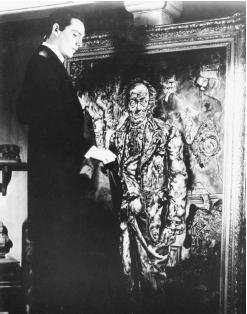
"The Portrait of Dorian Gray," Oscar Wilde
I know I'm revealing a defect deep within my soul, but I never found Lord Henry Wotton that witty a character. I always pictured him as carrying around a book of aphorisms, which he would study intensely so that he would always have a good reverse aphorism at hand. Then he would deploy his reverse aphorism, and polite laughter ensued!
Apparently Dorian was so awful that his portrait turned into a Marc Chagall!
Apparently Dorian was so awful that his portrait turned into a Marc Chagall!
"One Flew Over the Cuckoo's Nest," Ken Kesey
I've read this book before and I've always found it an easy read, despite it being incredibly misogynistic. The women in the book are mostly Bad: borderline-incestuous, overbearing mammas, oversexed bimbos, or sexually unappealing spinsters who take out their frustrations on the poor suffering maniacs under their care. Add a redemptive Christ figure, who uses rape as a tool against the (Wo)Man, and a lot of 60s bitching about "ticky-tacky houses" and the "Combine," and it's really pretty noxious. Yet I tear through it every time. I guess the idea of the glorious return to nature is just that appealing.
The movie is a much better bet - Milos Forman cut out a lot of the scenes from the book and re-imagined the rest, and it's just less gross overall. And you can't beat Jack Nicholson, Christopher Lloyd, Brad Dourif, and... Danny DeVito. Plus Kai Winn as Nurse Ratched! (All respect to Louise Fletcher - nobody can rock a goofy hat of evil like this lady.)
The movie is a much better bet - Milos Forman cut out a lot of the scenes from the book and re-imagined the rest, and it's just less gross overall. And you can't beat Jack Nicholson, Christopher Lloyd, Brad Dourif, and... Danny DeVito. Plus Kai Winn as Nurse Ratched! (All respect to Louise Fletcher - nobody can rock a goofy hat of evil like this lady.)
Friday, 25 January 2008
"Autobiography," John Stuart Mill
John Stuart Mill was one of the original liberals, back when that word meant "person who believes in individual rights and free trade" and not "weakling who hates America."* I've had to read this book twice, and each time I dreaded it, and each time I ended up reading the whole thing with ease. Mill's reputation as being dry as dust helps, because when you get to the parts about his nervous breakdown and the paeans to his wife, you're pleasantly surprised.
* I personally don't believe that liberals are weaklings who hate America, but then again it's not as if you can find an American who will willingly call him- or herself liberal anymore, so debating whether liberals are nasty or not is a bit like debating what color of rock candy the Big Rock Candy Mountain is made out of.
* I personally don't believe that liberals are weaklings who hate America, but then again it's not as if you can find an American who will willingly call him- or herself liberal anymore, so debating whether liberals are nasty or not is a bit like debating what color of rock candy the Big Rock Candy Mountain is made out of.
Monday, 14 January 2008
"Confessions of an English Opium-Eater," Thomas de Quincey
There are two versions of this book; I read the first edition, which is the comparatively straightforward tale of a boy, his adventures roughing it in early 1800s London, and his addiction to opium. The second edition was greatly expanded because de Quincey was not the type to pay his bills and he needed something to hook the readers in a second time, I suppose. Therefore there are long sections about the grandeur of the Whispering Gallery and so on.
De Quincey is a "philosopher," which means that he will go off on his favorite subjects (David Ricardo, how exactly he got a friend to help him raise money with a Jewish moneylender, why doctors are wrong about the effects of opium) at any time. Reading this style of memoir was a pleasant break from the modern addiction memoir, where the addict is generally so horribly enslaved that you never hear about anything else other than their sufferings. Maybe de Quincey was boring to his contemporaries, though, and I just find him interesting because he's quaint to me. I'm sure that Coleridge and Wordsworth flipped through the pages til they got to the good parts, where he freaks out and sees crocodiles trying to eat his walls.
De Quincey is a "philosopher," which means that he will go off on his favorite subjects (David Ricardo, how exactly he got a friend to help him raise money with a Jewish moneylender, why doctors are wrong about the effects of opium) at any time. Reading this style of memoir was a pleasant break from the modern addiction memoir, where the addict is generally so horribly enslaved that you never hear about anything else other than their sufferings. Maybe de Quincey was boring to his contemporaries, though, and I just find him interesting because he's quaint to me. I'm sure that Coleridge and Wordsworth flipped through the pages til they got to the good parts, where he freaks out and sees crocodiles trying to eat his walls.
Saturday, 12 January 2008
"Mrs. Dalloway," Virginia Woolf
I'm afraid that I don't have much to add to all the commentary there must already be on this wonderful book, so I'll just say that I absolutely adored it and read it in one sitting. I am embarrassed that a reading list was what finally got me restarted on the book, having unsuccessfully tried to read it all the way through a few years ago. I'd like to think that I now love Mrs. Dalloway because I am a grown woman and not a green girl, but it's probably just that I don't have cable anymore.
It was interesting to compare to Saturday, in that Saturday is supposed to be a homage to Mrs. Dalloway - yet the reader only gets one perspective in Saturday, and Woolf lets us into all her characters' thoughts. It certainly makes for a much less monotonous read, even if the only one anybody ever remembers after finishing is Clarissa.
It was interesting to compare to Saturday, in that Saturday is supposed to be a homage to Mrs. Dalloway - yet the reader only gets one perspective in Saturday, and Woolf lets us into all her characters' thoughts. It certainly makes for a much less monotonous read, even if the only one anybody ever remembers after finishing is Clarissa.
Subscribe to:
Posts (Atom)

 Posts
Posts