"Zami: A New Spelling of My Name" was written by Audre Lorde, black lesbian feminist poet. Books written by 70s feminists are always discussed as Historical Artifacts, because 20 years later everyone has realized (come back to the realization?) that women are conniving bitches who will go any lengths in their quest to leech off the power of the Man, since they have none of their own. Still, I personally like the idea of sisterhood better than the idea that I was born into something akin to Highlander, only determined by social codes of decorum and attractiveness instead of swords, even if the idea of sisterhood is a lie. So I liked "Zami."
It's odd, anyway, because most of the book isn't a manifesto for sisterhood, it's about growing up in Manhattan (way up in Manhattan) and about growing up lesbian. It's all very romantic, in a good way, not in a "they gazed sadly at each other and then spent the rest of the book angsting about their inversion" way. The descriptions of 1940s/50s New York are very evocative and make me nostalgic for my own imagined past - mainly a past made up of stories my mother told me, not from my own experiences in New York.
Friday, 14 March 2008


Friday, 7 March 2008
"A Wizard of Earthsea," Ursula K. Le Guin
I picked this YA fantasy up on a whim and spent a weekend night reading it - the equivalent of staying in and drinking hot cocoa, I suppose, comfort-wise. I had read "Tombs of Atuan" (the second in the Earthsea series) beforehand and found it absolutely fascinating - the girl-priestess wandering around in the secret caves, the air of cloistered unreality - so "Wizard" was a bit of a let-down in that it was a classic Hero's Journey. I'm just not much of one for the Hero's Journey in its classic form, I guess - give me the point of view of the wicked villain or the hanger-on or the tragic lovers. I do like Baby Cakes' description of the Hero's Journey, though. "I guess every one of us is just hoping to turn out to be one of those forgotten chosen ones." "Right!"
Fortunately, even so-so Le Guin is still a good read, and the prose was spare, which was a bonus. So much of adult fantasy is overwritten - "Wizard" seems quite similar in plot to "Name of the Wind," but it's about an eighth of the size, I'd estimate. Perhaps someday I will get round to finishing "Name," or perhaps not. There might be a call for a "Books I Haven't Read (And Why)" section on here. It would be more vituperative, at least.
PS. Ged is brown!
Fortunately, even so-so Le Guin is still a good read, and the prose was spare, which was a bonus. So much of adult fantasy is overwritten - "Wizard" seems quite similar in plot to "Name of the Wind," but it's about an eighth of the size, I'd estimate. Perhaps someday I will get round to finishing "Name," or perhaps not. There might be a call for a "Books I Haven't Read (And Why)" section on here. It would be more vituperative, at least.
PS. Ged is brown!
"Lady Chatterley's Lover," D.H. Lawrence
Everyone in the world (by which I mean everyone in my graduate-level English class) is still embarrassed by this book, although now it's probably more because of the written-out dialect than the sex. Also, whatever happened to Lady Chatterley's clitoris? This is a mystery that haunted me throughout my reading of the book.
Wednesday, 20 February 2008
"Taking It All In," Pauline Kael
I started reading Pauline Kael as a very young child, when I would pick up copies of "The New Yorker" in my parents' bedroom. The only things I could properly understand were the cartoons and the movie reviews. I'd like to say that this reading made a deep impression on me, and perhaps on some subconscious level it did, but consciously all I remember is snickering at a review of "Spanking the Monkey," which must have been published long after Kael retired. My first genuine contact with her film reviews was her first book, "I Lost it at the Movies," which I have read over and over, to the point where the cover is falling off and the pages are bent at the edges. ("Fantasies of the Art-House Audience" and "Hud, Deep in the Divided Heart of Hollywood" are some of the best take-downs of goopy Hollywood "liberalism" that I've read.)
It's hard to find Kael's longer reviews and essays, so when I ran across "Taking It All In," I snapped it up. The movies reviewed are from the early 80s, and I didn't find that the writing had the same snap as in her earlier works (Kael was diagnosed with Parkinson's disease around this time, although with essays like "Why Are Movies So Bad? Or, the Numbers", it could have just been sheer weariness at work). Nevertheless, there's a sense of pleasure in this book that's unmistakable, and Kael cares deeply about what she's reviewing in a way that you don't get with, say, David Denby (all right, I just want to bitch about David Denby).
A collection of Kael's capsule reviews.
It's hard to find Kael's longer reviews and essays, so when I ran across "Taking It All In," I snapped it up. The movies reviewed are from the early 80s, and I didn't find that the writing had the same snap as in her earlier works (Kael was diagnosed with Parkinson's disease around this time, although with essays like "Why Are Movies So Bad? Or, the Numbers", it could have just been sheer weariness at work). Nevertheless, there's a sense of pleasure in this book that's unmistakable, and Kael cares deeply about what she's reviewing in a way that you don't get with, say, David Denby (all right, I just want to bitch about David Denby).
A collection of Kael's capsule reviews.
"Fingersmith," Sarah Waters
I read over "Fingersmith" over two nights, and it took two nights only because the necessity of sleep intervened. It's hard for me to describe the plot of the novel, because it would take a lot of "and then... and then!" sort of description and also because I don't want to spoil it for anyone who hasn't picked it up yet. I'm shallow, so I admit that I started the book with the thought "ooh, Victorian lesbian erotica!" in mind, but Waters is really playing with the tropes of 19th-century sensation fiction here. (How could she top the ending of "Woman in White," anyway? Ménage à trois with two sisters...) There's a madhouse, an evil uncle, kidnapping, orphans, a criminal trial, and everything in between.
I found the first section the strongest - I'm a sucker for Victorian street urchins, what can I say? Since the section told from Maud's point of view is a retelling of what we've already seen through Sue's eyes, I found it a bit slow going, and I have to say that if I see one more book where the protagonist is redeemed by the act of writing I'll cry. All right, that's a bit far, but is it really necessary to justify the act of writing in the text itself? (I'm being unfair to Waters, who really doesn't go as far with this concept as many other authors I've read.)
Bonus: much of the action takes place in my neighborhood; Sue's haunt is close to the tube station I take almost every day.
I found the first section the strongest - I'm a sucker for Victorian street urchins, what can I say? Since the section told from Maud's point of view is a retelling of what we've already seen through Sue's eyes, I found it a bit slow going, and I have to say that if I see one more book where the protagonist is redeemed by the act of writing I'll cry. All right, that's a bit far, but is it really necessary to justify the act of writing in the text itself? (I'm being unfair to Waters, who really doesn't go as far with this concept as many other authors I've read.)
Bonus: much of the action takes place in my neighborhood; Sue's haunt is close to the tube station I take almost every day.
Sunday, 3 February 2008
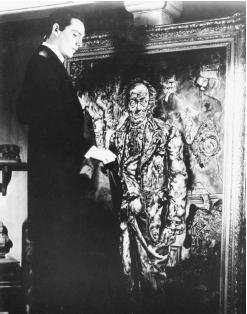
"The Portrait of Dorian Gray," Oscar Wilde
I know I'm revealing a defect deep within my soul, but I never found Lord Henry Wotton that witty a character. I always pictured him as carrying around a book of aphorisms, which he would study intensely so that he would always have a good reverse aphorism at hand. Then he would deploy his reverse aphorism, and polite laughter ensued!
Apparently Dorian was so awful that his portrait turned into a Marc Chagall!
Apparently Dorian was so awful that his portrait turned into a Marc Chagall!
"One Flew Over the Cuckoo's Nest," Ken Kesey
I've read this book before and I've always found it an easy read, despite it being incredibly misogynistic. The women in the book are mostly Bad: borderline-incestuous, overbearing mammas, oversexed bimbos, or sexually unappealing spinsters who take out their frustrations on the poor suffering maniacs under their care. Add a redemptive Christ figure, who uses rape as a tool against the (Wo)Man, and a lot of 60s bitching about "ticky-tacky houses" and the "Combine," and it's really pretty noxious. Yet I tear through it every time. I guess the idea of the glorious return to nature is just that appealing.
The movie is a much better bet - Milos Forman cut out a lot of the scenes from the book and re-imagined the rest, and it's just less gross overall. And you can't beat Jack Nicholson, Christopher Lloyd, Brad Dourif, and... Danny DeVito. Plus Kai Winn as Nurse Ratched! (All respect to Louise Fletcher - nobody can rock a goofy hat of evil like this lady.)
The movie is a much better bet - Milos Forman cut out a lot of the scenes from the book and re-imagined the rest, and it's just less gross overall. And you can't beat Jack Nicholson, Christopher Lloyd, Brad Dourif, and... Danny DeVito. Plus Kai Winn as Nurse Ratched! (All respect to Louise Fletcher - nobody can rock a goofy hat of evil like this lady.)
Subscribe to:
Posts (Atom)

 Posts
Posts